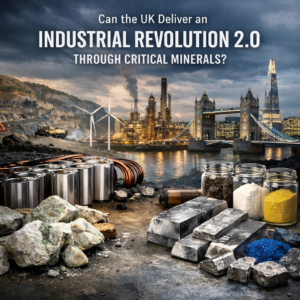
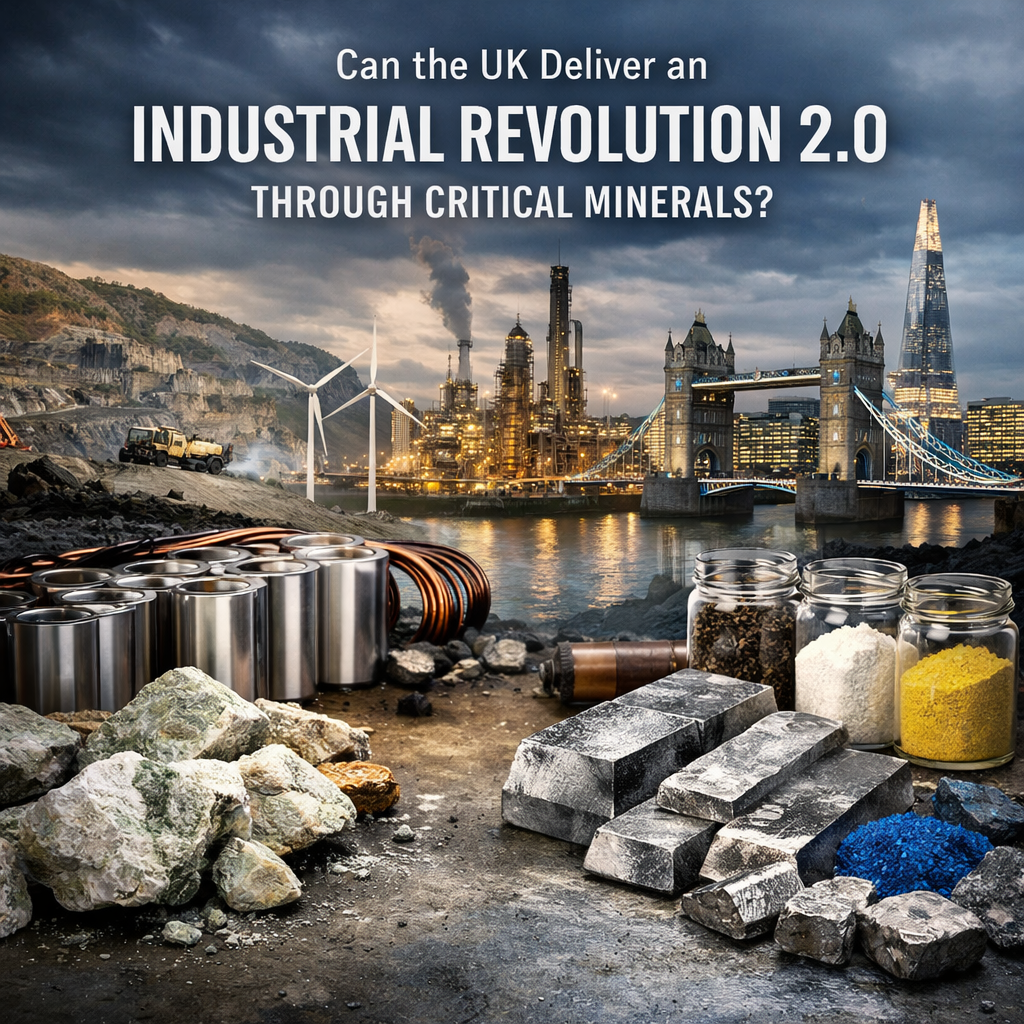
“Can the UK Deliver an Industrial Revolution 2.0 Through Critical Minerals?”
The phrase “Industrial Revolution 2.0” is often used casually, as shorthand for electrification, artificial intelligence and decarbonisation. Yet the historical Industrial Revolution was not driven by ideas alone. It was underpinned by physical inputs: coal, iron, steam infrastructure and maritime dominance. Britain did not merely innovate. It controlled the material base of production.
The modern equivalent of coal and iron is lithium, rare earth elements, copper, tungsten, fluorspar and graphite. These materials are the foundation of electric vehicles, grid storage, wind turbines, semiconductors and advanced defence systems. Without secure access to them, there is no green transition and no technological sovereignty.
The United Kingdom currently occupies an ambiguous position in this landscape. It retains deep capital markets, a respected legal system and global financial reach. London continues to finance mining projects across Africa, Central Asia and Latin America. Yet domestically, the country has limited extraction capacity and almost no large-scale refining infrastructure. In processing, it is not a leader.
This creates a structural vulnerability. The value chain of critical minerals is not confined to mining. The strategic leverage sits in processing and midstream conversion. Concentrates are of little use without chemical upgrading. Magnet metals are irrelevant without separation capacity. Battery materials are only strategic when refined to specification.
China recognised this decades ago and built dominance in refining and magnet production. The United States has responded with industrial policy and large fiscal support. The European Union is accelerating its Critical Raw Materials Act to reduce external dependency. In this context, the UK risks becoming a price taker in markets that determine the future of its own industrial base.
The question, therefore, is not whether Britain can mine more lithium in Cornwall or reopen tungsten projects. The more serious question is whether it can reposition itself within the global supply chain architecture.
There are three possible roles.
First, Britain could attempt full domestic integration from extraction to refining. This would be politically attractive but economically constrained. The geological base is limited. Permitting timelines are long. Capital intensity is high. This path alone is insufficient.
Second, Britain could retreat to advanced manufacturing while relying on imports for inputs. This would repeat the strategic exposure seen in gas markets and semiconductor shortages. It would undermine long-term resilience.
The third option is more realistic and potentially powerful. The UK can leverage its financial system, trading expertise and regulatory credibility to structure transparent, ESG-compliant supply chains anchored in long-term partnerships with resource nations. Instead of competing with China on scale, it can compete on governance, transparency and contractual sophistication.
This requires clarity of intent. Industrial strategy must align defence procurement, automotive transition, energy policy and capital allocation. Long-term offtake agreements must be encouraged rather than left entirely to private risk appetite. Refining capacity in key materials should be strategically supported where commercially viable. Most importantly, supply chain diplomacy must be treated as economic security, not as peripheral trade policy.
An Industrial Revolution 2.0 would not be announced through slogans. It would emerge from control over inputs. The first Industrial Revolution was secured through coal fields, shipping routes and financial dominance. The next one would depend on processing plants, mineral partnerships and capital discipline.
We believe Britain still has tools. It lacks only strategic coherence.
If critical minerals are understood as the foundation of technological sovereignty rather than as a niche commodity sector, the UK can remain central to the next industrial cycle. If not, it will finance revolutions that take place elsewhere.
That distinction is what we see will define the coming decade.
At present, QARAS develops structured critical mineral supply channels linking resource jurisdictions with European industrial demand. We are currently evaluating larger-scale cobalt and germanium-bearing tailings opportunities in the Gobi region, with a focus on technical viability, recoverability and long-term offtake alignment. In parallel, we are positioning around anticipated UK demand under the Vision 2035 Critical Minerals Strategy, particularly where supply security and midstream capacity remain underdeveloped.
Industrial transformation begins upstream. These questions of access, processing and strategic alignment will form part of our discussions at MiningWeek & MinePro 2026, London Strategic Edition, where the next phase of supply chain architecture is being discussed.